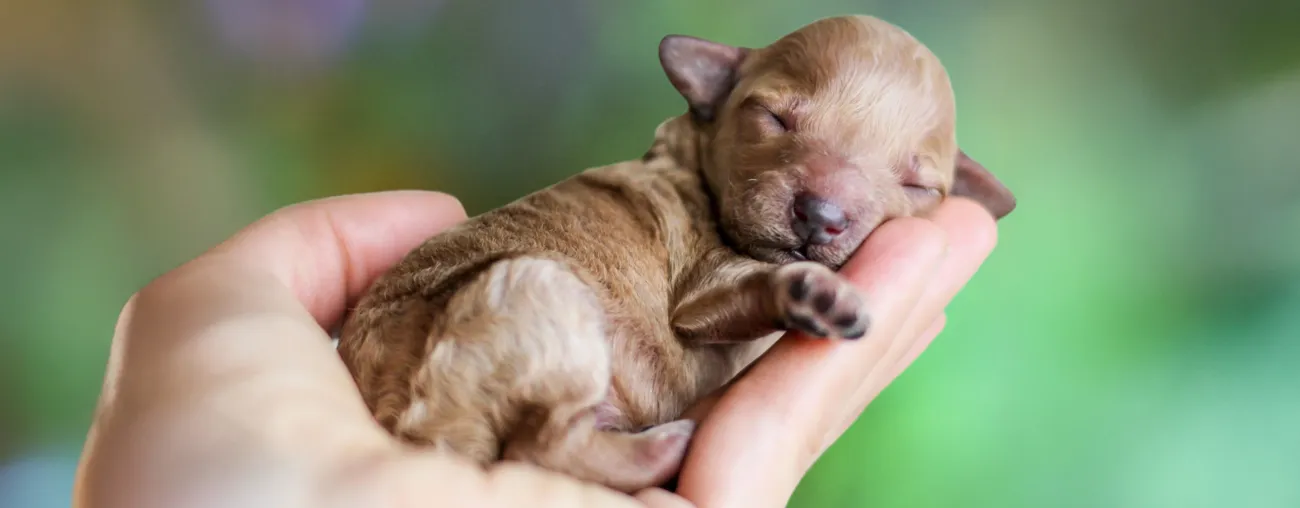
Breeders strive to produce nice-size litters of healthy puppies. Adhering to best practices that are recognized as promoting the welfare of breeding dogs will help you achieve your goals and ensure dogs’ health and well-being.
“There are many facets involved in providing care for breeding animals,” says Peggy Root Kustritz, DVM, PhD, DACT, a veterinary reproductive specialist and author of “The Dog Breeder’s Guide to Successful Breeding and Health Management.”
“The housing and the diet you provide breeding dogs, as well as how you manage brood females and stud dogs, are important for best outcomes,” she says.
Here, Dr. Root provides shares essential dog breeder tips and insights based on recommendations by the American College of Theriogenology (ACT), the veterinary specialty organization that certifies veterinarians as specialists in animal reproduction. She blends the information with her 40 years’ experience working with breeders as professor of small-animal reproduction at the University of Minnesota College of Veterinary Medicine.
The Best Kennel Environment & Proper Kennel Management
Breeding animals should be housed in an environment free of mental distress and one that promotes normal behaviors related to an individual dog’s temperament, according to the ACT. Male and female dogs should be housed in appropriate social units except when females are in estrus. The presence of females in heat may cause aggression between males that are housed with them or may cause aggression between the female in heat and other females in the unit.
Additionally, to maintain overall kennel health, kennels should be an appropriate size and well-maintained, the ACT says. Regular human observation of dogs and interactions are essential.
“At a minimum, every dog needs to be able to stand and move around, to get away from its waste and to have food and water available,” Dr. Root says. “The housing has to be easy to clean, to disinfect and to dry.
“An important consideration is not to use unpainted or unfinished wood in kennels,” she advises. “Bare wood is neither easy to disinfect nor easy to dry. You should never put a dog back into a wet kennel because it increases the risk of passing along infections and parasites.”
As for exercise, the reproductive expert says, “All dogs need regular exercise and regular interactions with humans. It has been shown that dogs that receive these interactions with humans are less likely to show nuisance behaviors.
“All dogs need regular exercise and regular interactions with humans. It has been shown that dogs that receive these interactions with humans are less likely to show nuisance behaviors.”
- Peggy Root Kustritz, DVM, PhD, DACT
“Caretakers should stop to pet dogs, talk to dogs, check dogs over, and sit and talk with dogs. These sorts of interactions are associated with better behaviors and better health. The more time we spend interacting with dogs, the better it is for dogs.”
Nutrition Requirements & Watchouts
Breeding animals should have access to an appropriate complete and balanced dog food for their life stage and be fed to maintain proper body condition, says the ACT. Clean, fresh water should be available at all times.
“The Purina Body Condition System is an important tool to determine how well a dog’s diet matches its energy needs,” Dr. Root says. “The goal is for a dog to be ‘ideal,’ which falls in the middle of the 9-point scale. You should be able to feel their ribs easily when doing body condition scoring, and there should not be a pad of fat on top of the hips or under the belly.
“Supplements, such as oral calcium for pregnant females and herbal and protein semen boosters given to stud dogs, are nutritional watchouts,” Dr. Root advises.
“If you give calcium during pregnancy, it tells the body it has enough calcium and it doesn’t need to draw on internal calcium stores in bones during lactation,” she says. “However, once a female whelps, she absolutely needs to pull calcium out of bone for lactation. If it takes time for the lactation system to kick in, you have disadvantaged her by giving oral calcium during pregnancy.
“Supplements to improve semen quality are not well-regulated,” Dr. Root says.
“Although it may not hurt to try a supplement, it may not help, as most are not proven by the Food and Drug Administration,” she says. “Your veterinarian can look at the list of ingredients to be sure there is nothing that could harm the dog.
“Importantly, it takes a couple of months for a dog to make new sperm before it appears in the ejaculate, so there is a big window of time before you can see if a supplement has had an impact.”
Breeding Timing & Age to Stop Breeding
The ACT advises breeders that females should not be bred on their first estrous cycle and not before they are physically mature. If you are wondering how often you can breed a dog, they should not produce more than five litters or be bred beyond the “critical age” for dogs of their body size, described as when litter size decreases 15 percent below average for the breed.
“A marker to know when a female is likely to go through her first heat is when she has attained 80 percent of her adult body weight. This may happen before she is physically and behaviorally mature,” Dr. Root says. “Physical maturity is linked to the skeletal closure of growth plates. Behavioral maturity occurs when she stands to be bred at the appropriate time.
“A marker to know when a female is likely to go through her first heat is when she has attained 80 percent of her adult body weight.”
- Peggy Root Kustritz, DVM, PhD, DACT
“Females should not be bred on their first estrous cycle because the concentration of reproductive hormones are lower and their sexual receptivity periods are shorter, suggesting they are not completely mature mentally or physically.
“For stud dogs, the timing of reproduction is when they show breeding behaviors and have normal semen,” she says. Much like puberty in females, it occurs around the time they reach 80 percent of their body weight, which is later with larger-size breeds.
“Timing for females and males may also be dependent on when you have completed prebreeding tests, including screenings for hereditary disorders, breed health testing and canine brucellosis,” she says.
While the critical age determination of decreased litter size helps to gauge the maximum age to breed a female, Dr. Root cites research based on data from commercial kennels showing that 5 years of age should be the general cutoff for breeding females.
“Health risks of breeding older females include lower conception rates, decreased litter size and increased risk of dystocia due to larger puppy size,” she says. “If a female is not bred the first time before 5 years of age, she may be more difficult to get pregnant due to changes in her uterus from repeated cycling without pregnancy.”
Dr. Root says, “The bottom line is to work in partnership with your veterinarian to provide optimal care and well-being for your breeding animals. Your veterinarian shares your goal of producing nice-size litters of healthy puppies.”
Housing, Diet & Breeding Frequency Recommendations
Kennel Housing
- Stud Dogs may be housed together or in mixed- gender groups, as long as females are not in estrus and as long as they get along together. Males should be separated from a female in estrus to prevent increased intermale aggression, which is normal behavior when a female is in estrus.
- Intact females housed together eventually go through estrus at the same time, a phenomenon known as the “dormitory effect.” It is important to look for signs of interfemale aggression, as some females are more aggressive during estrus if they share a kennel or are housed together.
- Pregnant females can stay in their regular kennel until close to whelping when they should be moved to a whelping box in a quiet area away from the general kennel population. You should consider moving her sooner if you are concerned about herpesvirus or other disease pathogens or if dogs don’t get along or play rambunctiously. A separate building, whelping room or area at the end of the kennel may provide safe housing.
Diet Considerations
- Stud dogs should be fed a complete and balanced adult food that provides the necessary nutrients, protein and fat in the correct proportion. Diet considerations include their age, size and body condition score. Palpable ribs without excess fat covering and the waist observable behind the ribs when viewed from above are desired.
- Intact females should be fed a complete and balanced adult food that provides the necessary nutrients, protein and fat in the correct proportion. This food will support a pregnant female during the first two trimesters (42 days) of pregnancy when embryos are developing but not growing significantly.
- Pregnant females do not require a diet change until the last trimester of pregnancy, when they should transition to an energy-dense growth or performance diet that provides from 22 to 30 percent protein and about 20 percent fat. This will support the growing fetuses and the female during whelping and the energy-intensive lactation stage.
Breeding Frequency
- Stud dogs can be used frequently for breeding with little physical or mental impact to their well-being. If a male breeds naturally or if his semen is collected daily for more than 3 to 5 days consecutively, his libido may decrease. Likewise, the number of spermatozoa, or male sex cells, may decrease if the semen is collected on 2 consecutive days. Be cautious of overuse of a male leading to popular sire syndrome in which disease genes are spread throughout a small gene pool.
- Pros in favor of breeding intact females on their first estrus cycle after pregnancy include a decrease in false pregnancy, decreased risk of neoplasia (tumors) and increased likelihood of getting desired litters before they age out of breeding or develop pyometra, the most common female reproductive disorder. Cons include the physical stress of pregnancy and lactation. Importantly, you must ensure that a female has regained normal body condition before being bred again.
Additional Resources for Dog Breeders
At Pro Club, we aim to offer valuable resources and dog breeder tips for professionals like you. Explore our collection of webinars, articles, and videos designed to support your professional breeding program.